
SC14 Gordon Bell Prize finalists
 Last year we tried, but did not succeed. This year is different, and our
submission was selected as a finalist for the Gordon Bell Prize at
the Supercomputing 2014 conference.
Last year we tried, but did not succeed. This year is different, and our
submission was selected as a finalist for the Gordon Bell Prize at
the Supercomputing 2014 conference.
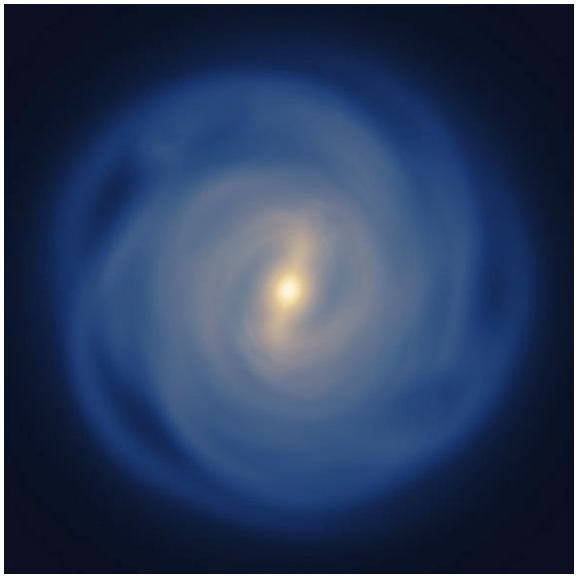
It was an amazing project with an ambitious goal to model the Milky Way Galaxy on a star-by-star basis using the Titan supercomputer. While we weren't able to simulate the whole Galaxy one a star-by-star basis, we did simulated a slight smaller model with a total of 50 billion particles using Swiss Piz Daint supercomputer. This is the biggest Milky Way simulation by far (1000x more particles), and it provides wealth of data to compare with observations. Our application also achieved a sustained performance of 24.8 Petaflops on 18600 GPUs on Titan supercomputer. Once the team will be able to secure more compute time, we have all the tools at our disposal to simulate the Milky Way with about 50 billion stars (or about 300 billion particles in total, most of the particle will comprise Dark Matter).